
In the sprawling, complex world of global supply chains, a silent revolution is underway. The movement of goods, once reliant on manual processes and reams of paperwork, is being transformed by a wave of intelligent automation. From autonomous robots in warehouses to self-optimizing software that charts the most efficient shipping routes, logistics automation is becoming the invisible engine that powers modern commerce. This shift is driven by the relentless demand for speed, accuracy, and resilience, pushing companies to replace human-dependent tasks with intelligent systems that can operate around the clock. The result is a fundamental reinvention of how products are stored, sorted, and shipped across the globe.
According to Straits Research, the global logistics automation size was valued at USD 34 billion in 2024. It is projected to reach from USD 37.47 billion in 2025 to USD 81.49 billion by 2033, growing at a CAGR of 10.2% during the forecast period (2025-2033). This robust growth reflects a strategic imperative for businesses to build supply chains that are not just faster, but smarter and more adaptable to disruption.
The Automated Flow: From Warehouse to Last Mile
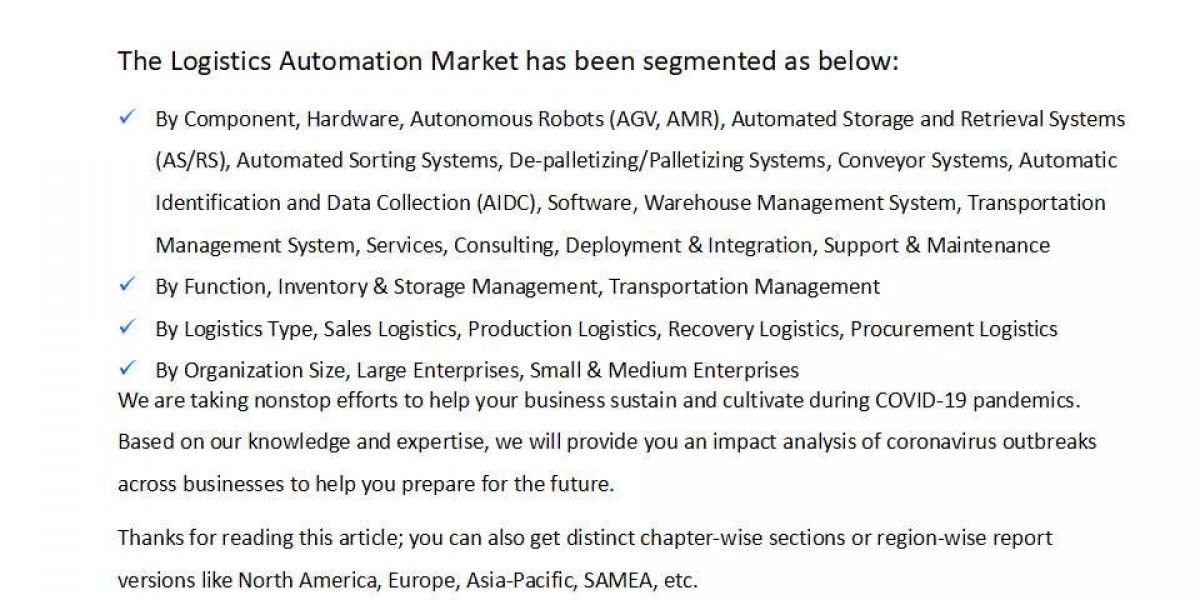
Logistics automation spans the entire supply chain, creating a seamless flow of goods. Inside distribution centers, Autonomous Mobile Robots (AMRs) have become commonplace. Companies like Locus Robotics (USA) and 6 River Systems (USA), now part of Ocado Group (UK), deploy collaborative robots that work alongside human workers, guiding them to items and reducing walking time by up to 70%. Recent updates from Locus focus on enhanced multi-bot fleet management software, allowing for more dynamic response to fluctuating order volumes.
Beyond mobile robots, automated sortation and storage systems are reaching new levels of sophistication. Dematic (USA) and Honeywell Intelligrated (USA) are leaders in deploying automated storage and retrieval systems (AS/RS) and high-speed sortation arms that can handle thousands of parcels per hour. Recent innovations involve using advanced machine vision to identify and sort packages based on size, shape, and destination without any barcode scans, dramatically improving throughput.
On the transportation side, the focus is on software-driven optimization. ToolsGroup (USA), a supply chain software provider, recently announced new AI-powered capabilities for its retail planning platform, enabling more accurate demand forecasting and dynamic inventory replenishment. This ensures the right products are in the right place before automated systems even begin the picking process.
Key Players and Global Strategic Shifts
The competitive landscape is a mix of industrial automation giants, specialized robotics firms, and enterprise software leaders.
KION Group (Germany): Through its brands Dematic and Linde Material Handling, KION is a global powerhouse in warehouse automation. Their recent strategic updates involve a strong push into cloud-based software with the Dematic iQ platform, which uses data analytics to optimize the performance of entire automated fleets, predicting maintenance needs before breakdowns occur.
Daifuku Co., Ltd. (Japan): A leading player in Asia, Daifuku has been aggressively expanding its global footprint. Recent news includes major contracts for fully automated logistics systems for e-commerce giants and airport baggage handling systems. Their technology emphasizes ultra-high-speed sortation and seamless integration of various automation technologies.
Oracle (USA) & SAP (Germany): The enterprise software titans are embedding automation deeper into their supply chain management suites. Oracle recently enhanced its Fusion Cloud Supply Chain & Manufacturing (SCM) with more advanced logistics modeling, while SAP is integrating its logistics solutions with the SAP Business Technology Platform to allow companies to build custom automation workflows.
Zebra Technologies (USA): Known for its barcode scanners and mobile computers, Zebra has evolved into a key enabler of automation. Their recent acquisitions and product launches focus on machine vision and fixed industrial scanning solutions that provide the "eyes" for automated systems, ensuring accurate tracking from receiving to shipping.
Emerging Trends and Recent Headlines
The field is advancing rapidly, with several key trends making recent headlines:
The Rise of "Dark Warehouses": The concept of fully automated, "lights-out" fulfillment centers is becoming a reality. Ocado (UK) continues to be a pioneer, with recent news highlighting the opening of new customer fulfillment centers for retailers like Kroger (USA) that are heavily automated, using swarms of thousands of robots to fulfill grocery orders with minimal human intervention.
AI-Powered Predictive Logistics: The next frontier is moving from automation to autonomy. AI algorithms are now being used not just to execute tasks but to predict and prevent disruptions. A recent partnership between Microsoft (USA) and FedEx (USA) aims to combine data from the FedEx network with AI analytics to provide businesses with insights into potential shipping delays before they happen.
Automation-as-a-Service (AaaS): To lower the barrier to entry, companies like Locus Robotics and Berkshire Grey (USA) are offering robotics and automation solutions on a subscription or "robotics-as-a-service" (RaaS) model. This allows smaller warehouses to benefit from automation without massive upfront capital investment, a trend gaining significant traction.
Sustainability Through Optimization: A powerful new driver for automation is sustainability. By optimizing warehouse space, inventory levels, and transportation routes, automated systems can significantly reduce energy consumption, fuel usage, and overall carbon footprint. This is becoming a key part of corporate ESG (Environmental, Social, and Governance) strategies.
The Future: Toward Autonomous, Self-Healing Supply Chains
The ultimate goal of logistics automation is the creation of a fully autonomous, resilient supply chain. The future lies in interconnected systems where AI doesn't just manage individual warehouses or trucks but orchestrates the entire network in real-time. Imagine a system that automatically reroutes shipments around a port closure, dynamically reallocates inventory between warehouses based on live sales data, and schedules predictive maintenance for robots before they fail. This shift from simple automation to cognitive, self-correcting logistics will define the next decade of global trade, creating supply chains that are not only efficient but inherently robust.
In summary, logistics automation is rapidly evolving from isolated robotic applications to integrated, intelligent systems that control the entire flow of goods. With global players advancing robotics, AI, and data analytics, the industry is building a more efficient, resilient, and responsive backbone for global commerce.